Home
Reporting & Analytics
Reporting
Conversion Report
Conversion Report

SERIES:

Conversion Report

Learn how to use the Conversion Report to track successful conversions and optimize performance across your Offers and Partners.

Overview

In Everflow, a Conversion (CV) represents a successfully completed action that was the goal of your Offer - like a purchase, app install, or subscription sign-up.

The Conversion Report helps you validate the quality of these actions by showing which Conversions were Approved, Invalid, Pending, or Rejected, along with detailed error messages explaining why certain Conversions weren't counted.

This helps you spot fraud patterns, track valid sales, and ensure you're only paying Partners for genuine Conversions.

But let's explore the main features and uses of this report!

What's Changed Last updated Nov 20, 2026 ▼
Nov 20, 2026 Added
New section: How To Reject Conversions, with steps for one or many Conversions, Conversions on paused Offers, and large batches by CSV (CSDOCS-635). Fixed the three Related Content links, which pointed nowhere.

Key Features

Feature
Description
Detailed Conversion Data
View individual Conversions with associated metrics.
Flexible Filtering
Apply various filters to focus on specific Offers, Partners, date ranges, or other criteria.
Customizable Columns
Tailor your report view to show the metrics most relevant to your analysis.
Conversion Status Tracking
Monitor or change the status of approved, pending, rejected, and invalid Conversions.
Advanced Tools
Access features like the Flowchart for detailed Conversion analysis.

How to Access and Use the Conversion Report

Click on the hamburger menu
in the top left corner of your Everflow dashboard.
Go to the
Reporting
section and select
Conversion
report.
Set your desired date range using the calendar selector
.
Apply relevant filters using the
Add Filter
option.
Click
Run Report
to generate your data.
Review the summary section for an overview of Conversion metrics.
Scroll down for a detailed report with individual Conversions.

Customizing Your Report

Column Customization: Click the vertical dots
at the top right of the detailed report to add or remove columns.
Conversion Status Filter: Use the dropdown menu next to the search bar to filter by Conversion status (Approved, Pending, Rejected, Invalid).
Search Functionality: Use the search bar
to find specific Conversions by various identifiers like Conversion IP, Transaction ID, or other parameters.
Using Filters, Columns Customization, and other features.
Save and Load Reports: Click the vertical dots
at the top right of the page to save your current report configuration or load a previously saved one.
Schedule Reports: Set up automatic report generation and delivery on a recurring basis.
Request Report: Generate a one-time report for large datasets that may take longer to process.
Copy Link to Report: Share your current report configuration with team members via a direct link.
Show API Request: View the API call needed to generate the current report, useful for integrating with other tools or automating report generation.

Advanced Features

Feature
Description
Flowchart
Click the vertical dots
at the end of any Conversion row and select"
View Flowchart
to see a detailed visualization of the Conversion process.
Conversion Details
Access in-depth information about each Conversion by selecting
View Conversion Details
from the row menu.
History
View the history of changes made to a Conversion by selecting
View History
from the row menu.
Click Details
Analyze the associated Click data by choosing
View Click Details
.
Partner and Advertiser Postbacks
Inspect the postback data sent to Partners and received from Advertisers by selecting the respective options.
Offer, Advertiser, and Partner Info
Quickly access related information by selecting
View Offer
,
View Advertiser
, or
View Partner
from the row menu.
Conversion Status Management
Change the status of a Conversion (e.g.,
Set As Rejected
) directly from the report.
Revenue and Payout Adjustment
Modify the Revenue, Payout, or Sale amount for individual Conversions as needed.
Bulk Actions
Use the checkboxes to select multiple Conversions and perform actions like rejecting or approving in bulk.

How To Reject Conversions

Reject a Conversion when it should not count, for example a duplicate, a test, a refund, or traffic that broke your terms. A rejected Conversion stays in your reports with the Rejected status, so you can always see what happened to it.

1
Find the Conversions
Go to
Reporting → Conversion Report
, set the date range, and use Add Filter to narrow it to the Offer or Partner. Click Run Report.
2
Reject one Conversion
Click the vertical dots at the end of the row and select Set As Rejected.
3
Or reject several at once
Tick the checkbox on each Conversion you want to change, then use the bulk action to reject them together.
4
Check the result
The Conversion now shows the Rejected status. Select View History from the row menu to see who changed it and when.
Revenue and payout change with the status
When a Conversion moves from Approved to Rejected, or back again, its revenue and payout change with it. Check the totals for that Partner after a large change.

Conversions On Paused Offers

A paused Offer still tracks clicks and Conversions, but they show no revenue and no payout for your Partners. To clean them up, filter the Conversion Report by that Offer, check which ones should not count, and reject them with the steps above. See Offer’s General Settings for what each Offer status does.

Rejecting A Large Batch

For a long list, use a CSV upload instead of the report. See How To Generate Or Update Conversions Via CSV Upload. If several Conversions share one Transaction ID (for example a base Conversion and its events), list them by Conversion ID so only the ones you mean are changed. Developers can also change status in bulk with the Update Conversion Status API.

Note
On Hold Conversions are handled separately and can only be rejected by hand. See On Hold Conversions.

Finding a Specific On-Hold Conversion by ID

If you need to locate a single On-Hold Conversion, you can now search for it directly by its On-Hold Conversion ID from Everflow's global Search panel, instead of exporting all On-Hold Conversions to a CSV and searching through them manually.

For full setup and management of On-Hold Conversions, see On-Hold Conversions.
Open the Search panel using the search icon
in the left sidebar of your Everflow dashboard.
Enter the
On-Hold Conversion ID
you are looking for.
The matching record appears tagged ON HOLD CONVERSION, showing its offer, partner, date and time, and ID. Results appear under the
All
tab alongside the relevant category tab.

Note: Searching by On-Hold Conversion ID uses the same access and permissions as the existing Conversion Search — if you can use Conversion Search, you can use this.
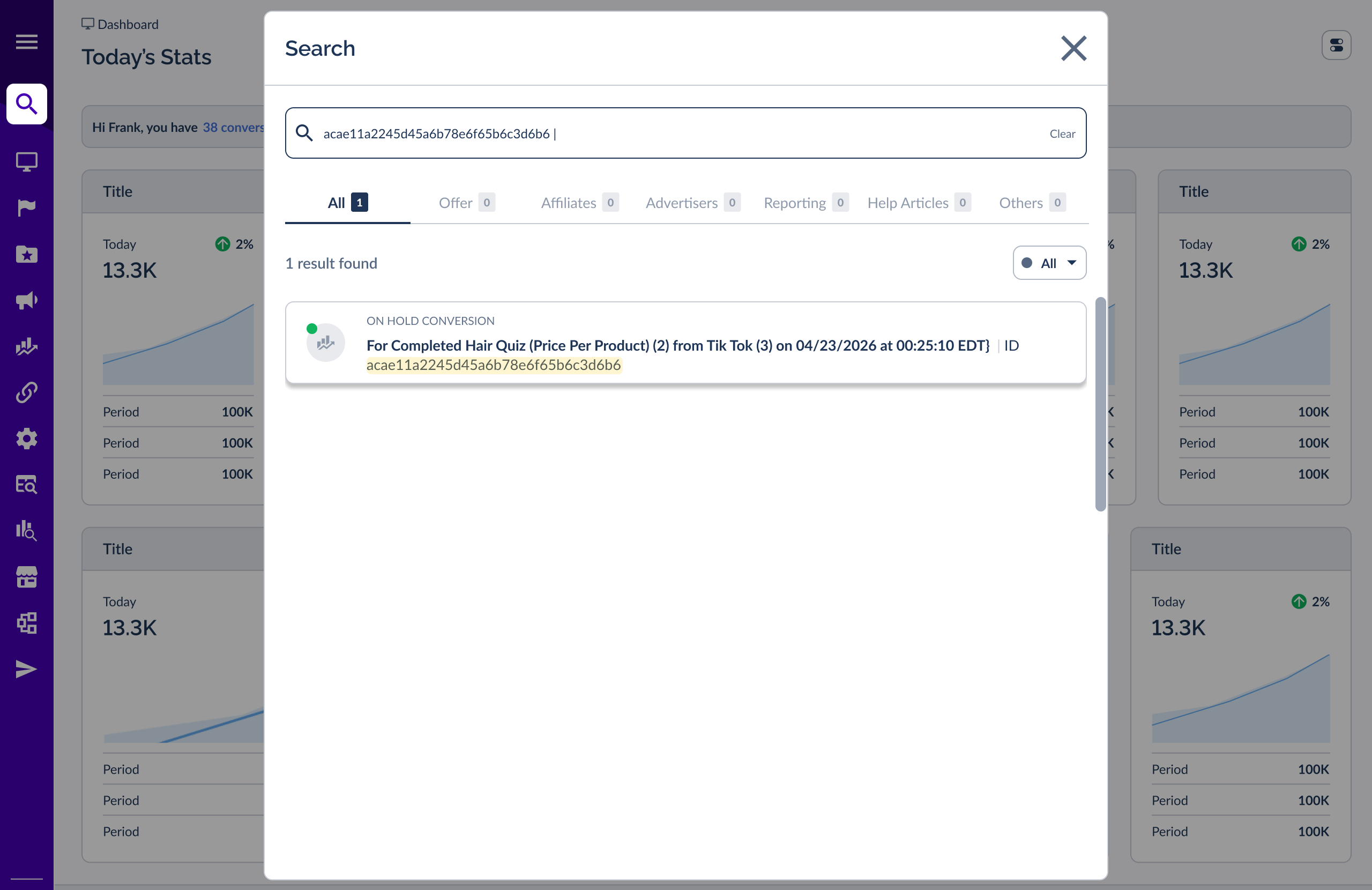
Searching by On-Hold Conversion ID in the Everflow Search panel
Searching by On-Hold Conversion ID returns the matching ON HOLD CONVERSION record.

Aggregating Report Data

To get a broader view of your Conversion data:

Click the vertical dots
at the top right of the detailed report.
Select
Aggregate Results
under the
Export
option.
In the
Aggregated Report Export
window that appears:
Note the "Heads up!" message explaining that the report will be generated as a request and you'll be notified via email when it's ready.
Under
Group By Columns
, you'll see two sections:
Available
and
Selected
.
Choose the columns you want to aggregate:
Available options include Status, Sub1-Sub10, and other tracking parameters.
Already selected options typically include Adv5, Advertiser, Offer, Offer Group, Partner, Revenue & Payout ID, and Smart Link.
Use the search bar
to quickly find specific columns in both available and selected lists.
You can use
Select All
or
Clear All
buttons to quickly add or remove all columns.
Once you've chosen your desired columns, click
Send Request
.
You'll receive an email when the aggregated report is ready to download.

This feature allows you to easily analyze trends across different dimensions of your data.

For example, you could aggregate data by Offer and Partner to see which Partnerships are most effective, or by Sub IDs to evaluate the performance of specific traffic sources or campaigns.

A Real-Life Example

Let's say you run "BloomBox," selling plant subscriptions:

Looking at your "$49.99 Starter Bundle" last week:
Partner A (PlantTok): 845 purchases tried, 30% Invalid due to missing data
Partner B (GreenThumb Blog): 234 Conversions, all good
Partner C (Plant Deals Daily): 90% Rejected for wrong country
What you found:
Partner A had a broken checkout form
Partner B's sales spike after their plant care guides
Partner C was targeting the wrong country
What you did:
Helped Partner A fix their form
Increase the Payout for Partner B
Asked Partner C to fix their targeting

Best Practices

Stay on top of your non-approved Conversions by checking them regularly to catch and fix any problems early. The aggregated report feature helps you spot patterns in Conversion quality across your different Offers and Partners.

When you need to solve specific problems, the flowchart feature can help you figure out what's going wrong.

To make all this easier, customize your column view so you can quickly understand the details of each Conversion.

Next in This Series